
Quick Answer
How to Become a Travel Agent in New York
You don’t need a state license to become a travel agent in New York! Most new agents join a host agency, finish its training, pick a niche, and register a business name with their county clerk. If you form an LLC, New York also makes you publish a notice in two newspapers for six weeks. Depending on your county, that costs roughly $400 to $1,800.
- Choose a host agency or independent travel-business model.
- Complete travel-agent and supplier training.
- Verify New York state business, seller-of-travel, and local requirements.
- Set up your client process, policies, and business tools.
- Choose a niche and start marketing to potential clients.
Important: Travel-business rules can change. Confirm current requirements with the appropriate state authority and your host agency before you begin selling travel.
See the Full Step-by-Step ProcessKey Takeaways
- You do not need a travel agent license or Seller of Travel registration to operate in New York.
- However, New York’s Truth in Travel Act still prohibits misleading travel sales.
- If you form an LLC in New York, you must publish a notice in newspapers within 120 days.
- To sell travel insurance in New York, you need an insurance license.
- The average travel agent in New York earns $55,580 per year, which is about 11% higher than the national average.
- New York City’s 4% business tax typically does not apply until your earnings reach a higher level.

What Does a Travel Agent Do These Days?
Today’s travel agent, often called a travel advisor, does much more than just print tickets. You design trips, solve problems, and look out for your clients!
Here’s what a typical week might look like:
- Consultations: You learn about your client’s budget, travel dates, and what they really want from their trip.
- Curating options: You sort through many possibilities and narrow them down to the top three choices.
- Booking and tracking: You make reservations, keep track of important deadlines, and double-check every detail.
- Adding perks: You secure upgrades, credits, and extra benefits for your clients through supplier programs.
- Fixing problems: If a nor’easter shuts down LaGuardia, you help your clients rebook and adjust their plans.
- Following up: After the trip, you check in with your clients and ask if they know anyone else who might need your help.

Do You Need a License to Be a Travel Agent in New York?
No, you do not need a license to be a travel agent in New York. The state does not require Seller of Travel registration either. According to the state’s consumer office, travel agents are not licensed in New York.
However, just because there is no license does not mean there are no rules. It is important to keep these points separate:
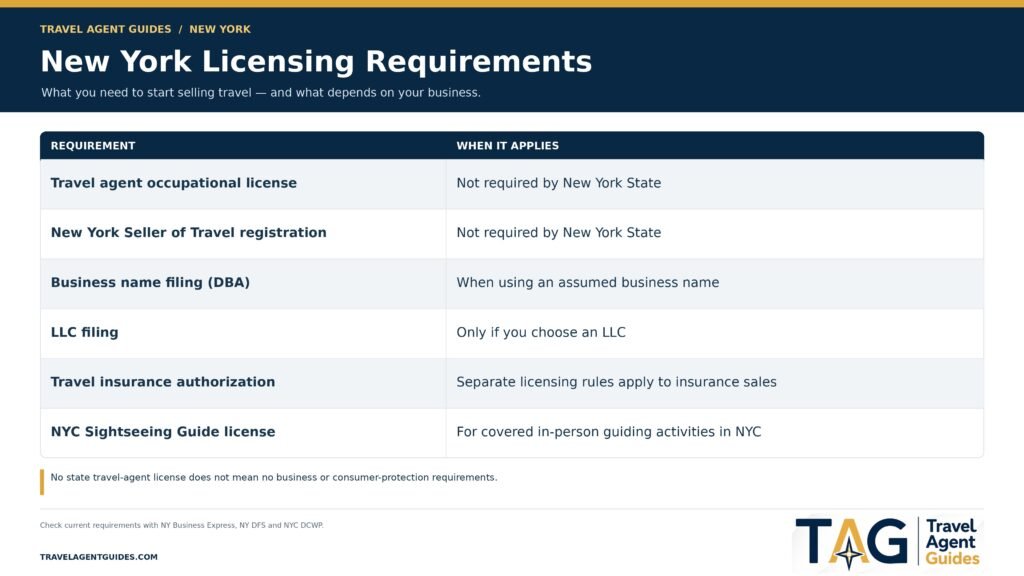
Be careful with search results that can be confusing. For example, the New York education department has a page listing “Travel/Tourism” education and experience requirements, but it is about teaching certification, not about getting a license to sell travel.
What about clients in other states?
California, Florida, Hawaii, and Washington have Seller of Travel programs. Their rules may apply depending on where your client lives, not where you are based.
Industry sources say that Maryland’s new Seller of Travel law started in October 2026, so check with your host agency about this as well.

How to Become a Travel Agent in New York: 9 Simple Steps
Step 1: Decide How You Want to Work
There are four main options:
- Employee: You get a steady paycheck and on-the-job training, but have less freedom.
- Independent agent with a host agency: You run your own business with built-in support. This is usually the best choice for beginners.
- Franchise: You work under a well-known brand, but you’ll pay higher startup and ongoing fees.
- Fully independent agency: You have complete control, but you’ll need to manage accreditation, supplier contracts, and compliance on your own.
My advice, if you want to run your own business, start with a host agency. You’ll get booking credentials, training, commission tracking, and Seller of Travel coverage in other states right from the start.
Step 2: Choose a Niche That Works in New York
You can book any type of travel, but it’s best to focus on one or two specialties. This makes marketing easier and helps you learn more quickly.
Here are some niches that work especially well in New York:
- Theme parks: Many people in New York travel to Orlando, and there are nonstop flights from JFK, LaGuardia, Newark, Islip, White Plains, Albany, Syracuse, Rochester, and Buffalo.
- No-fly cruises: Your clients can sail from Manhattan or Brooklyn without needing to go to the airport.
- Winter all-inclusives: Getting away from the gray weather between November and April is almost a tradition in New York.
- Europe: With direct flights from JFK and Newark, trips to Italy, France, and Greece are easy to sell.
- Destination weddings: Because local venues are expensive, many couples choose the Caribbean or Mexico for their weddings.
- Corporate and group travel: This is a great fit for Manhattan.
Step 3: Compare Host Agencies Carefully
Don’t pick a host agency just because of something you saw on social media. Make sure to ask each agency these questions:
- What’s my commission split, and how do I move up?
- Are there monthly, annual, or per-booking fees?
- What does training actually cover?
- Who helps me with a live booking problem?
- Does the agency include errors and omissions (E&O) insurance? This type of insurance protects you if a client claims you made a mistake.
- Which states’ Seller of Travel registrations cover me?
- How do you handle travel insurance for New York agents?
- Can I use my own brand name?
- Who owns my client list if I leave?
Watch out if the agency focuses more on recruiting your friends than on selling travel. That’s a sign to look elsewhere.

Step 4: Get Practical Training
You don’t need a college degree to get started in New York. According to the Bureau of Labor Statistics, most people begin with a high school diploma.
Build your training in layers:
- Your host’s onboarding: How to quote, book, take payments, and track deadlines.
- Supplier courses: Free programs from theme parks, cruise lines, and resort brands that match your niche.
- Optional credentials later: The Travel Institute’s CTA and CTC designations, or ASTA education.
Complete three or four courses that fit your niche, then start reaching out to clients. There’s no need to spend months collecting certificates before you begin.
Step 5: Register Your Business in New York
Here’s where New York stands out compared to other states.
Option A: Sole proprietor (cheapest and fastest)
- If you’re using your own legal name for your business, you don’t need to file any paperwork for the name.
- If you want to use a brand name, such as “Hudson Valley Getaways,” you’ll need to file a Business Certificate (DBA) with your county clerk. This document must be notarized.
- The filing fee is usually $25 to $35 if you’re upstate, or $100 to $120 in the five NYC boroughs. Most banks will also ask for a certified copy, which costs a bit more.
Option B: LLC (more liability protection)
- You’ll need to file Articles of Organization with the New York Department of State, which costs $200.
- Make sure to create a written operating agreement within 90 days.
- You’ll also need to publish a notice in two newspapers—one daily and one weekly—selected by your county clerk. This must be done once a week for six weeks.
- After publishing, file a Certificate of Publication for $50. Make sure to complete this within 120 days of forming your LLC.
If you miss the 120-day deadline, your LLC will lose its authority to do business until you file the required paperwork.
What publication costs (typical all-in service prices):
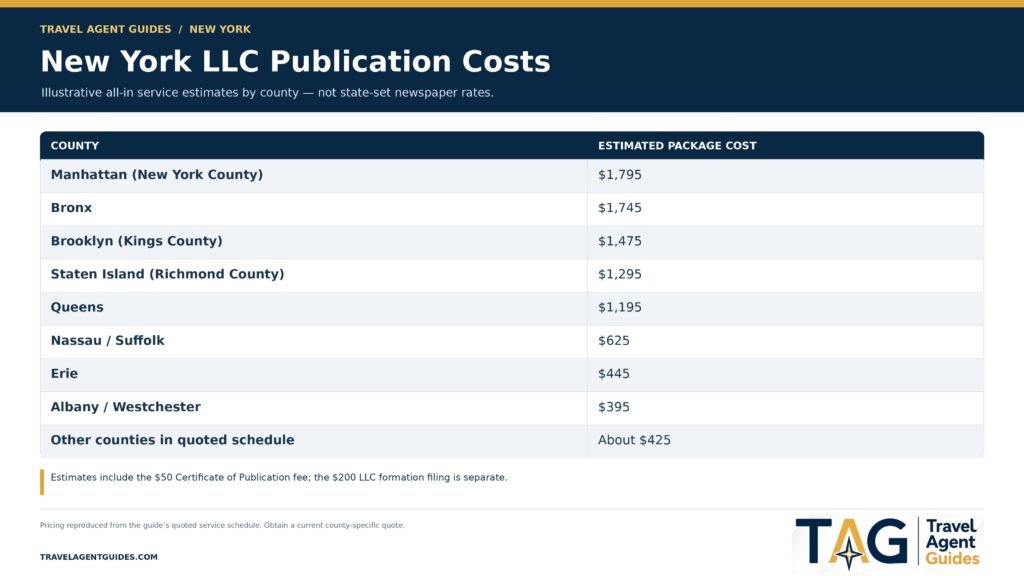
You need to publish in the county where your LLC’s office is located. Before choosing an address, speak with a New York attorney or CPA.
Next, complete your setup:
- Get a free EIN at irs.gov. Don’t pay any third-party sites for this service.
- Open a business bank account.
- Start simple bookkeeping right away.
Step 6: Learn New York’s Travel Rules
- The Truth in Travel Act (GBL Article 10-A)
New York makes it illegal for travel sellers to knowingly:
- Misstate the type of service, aircraft, ship, route, stops, or trip time.
- Misstate fares or charges.
- Claim a reservation is confirmed without a binding commitment from the supplier.
- Promise special reservation priority that isn’t really available.
- Sell tickets that carriers won’t honor.
The law also requires written disclosures within five business days and gives clients three business days to cancel. This mainly applies to “travel promoters” who contact people directly, but there are exceptions. As a best practice, always send written terms with the supplier, price, payment dates, and cancellation rules right after booking.
- Travel Insurance Needs a License
New York’s Department of Financial Services (DFS) requires travel agents to have an insurance license to sell travel insurance. You can get a limited license without an exam or continuing education. DFS also says that cruise lines or tour operators cannot pay you a commission on packages with insurance unless you are licensed.
The New York Travel Insurance Act passed both houses in 2025 but was vetoed in December. A new version was introduced in 2026. Check the current status before selling insurance.
Until then:
- Ask your host exactly how New York agents handle insurance.
- If you aren’t licensed, don’t recommend specific policies.
- Give clients the insurer’s direct link and make it clear that they are choosing on their own.
- Sales Tax On Hotels You Mark Up
If the hotel sets the rate and you earn a commission, you do not need to worry about sales tax. But if you buy rooms at a net rate and set your own price, New York considers you a “room remarketer.” In that case, you must register for sales tax and collect it. New York City also adds a $1.50 fee per room, per night. The simple rule: if you set the price, talk to a CPA.

Step 7: Know Your Taxes
- You’ll need to pay federal, self-employment, and New York State income taxes. If you live in NYC or Yonkers, you’ll also owe city tax.
- The NYC Unincorporated Business Tax (UBT) is a 4% city tax for sole proprietors and LLCs. You usually don’t need to file unless your gross income is over $95,000. If your bill is $3,400 or less, a credit will cover it.
- Planning fees and commissions usually aren’t taxed, but things can get tricky if you offer bundled packages.
For example, Priya in Queens earns $30,000 in her first year, so she probably doesn’t owe any UBT. Once her gross income goes over $95,000, she’ll work with a CPA to plan ahead.
I recommend saving 25% to 30% of each commission check for taxes, and make sure to pay your estimated taxes every quarter.
Step 8: Protect Your Business
- Check your host’s E&O insurance to see what the coverage limits and deductible are.
- Ask clients to sign your terms before you make any bookings for them.
- If a client says no to travel protection, make sure you get their decision in writing.
- Always use your host’s or the supplier’s payment system for client payments. Don’t accept Venmo or Zelle in your personal account.
Step 9: Find Your First Clients
Finding clients can be frustrating when starting off, so we’re providing some tips below to help you. Start with your own network. Send 30 personal messages, not one generic post:
“Hey Mark! Just a quick update, I’m now a travel advisor focused on family cruises and Caribbean resorts. My help is free on most resort and cruise bookings. When you start thinking about February break, let me run some options for you.”
Next, work on building your presence in your local area.
- Set up your Google Business Profile as a service-area business. This way, your home address stays private.
- Create local pages with names like “Disney Travel Agent Long Island” or “Cruise Travel Agent Brooklyn.”
- Write posts that answer real questions, such as “When should I book a February break cruise from NYC?”
- Connect with referral partners like wedding planners, parent groups, and local business groups.

How to Use New York to Your Advantage
- Sell No-fly Cruises
- At Manhattan Cruise Terminal, located at Piers 88 and 90, you’ll find ships from Norwegian, Carnival, Oceania, and Regent.
- Brooklyn Cruise Terminal in Red Hook is where Cunard’s Queen Mary 2 and Virgin Voyages dock.
- Cape Liberty (Bayonne, NJ): Just across the harbor and a major Royal Caribbean hub.
Here’s a tip: Apply for ship inspections when ships are in port. Spending just one afternoon can get you original photos and videos, which help sell cabins much better than using stock images.
- Plan Around New York School Breaks
During February break (Presidents’ Week) and spring break, millions of families leave town on the same Friday. Start promoting February trips in May and June, and spring break trips in late summer. If you help families secure their deposits early, they’ll really appreciate it.
- Know Airport Tricks
- For downstate travelers, compare JFK, LaGuardia, and Newark, but don’t forget quieter airports like Islip, White Plains, and Newburgh.
- If you have clients in western New York, they can often save money by flying out of Toronto Pearson. Just make sure to check their passport requirements first.
- Go To Events the Whole Industry Travels To
- New York Travel & Adventure Show: January 23–24, 2027 at the Javits Center, with sessions just for advisors.
- Local ASTA and PATA chapters host regular networking and supplier events.
- Supplier roadshows: Free breakfasts and lunches where you meet the supplier reps who approve perks and FAM invitations.

FAM Trips: Learn as You Travel
FAM (familiarization) trips are discounted opportunities for agents to see resorts, ships, or destinations in person, guided by suppliers.
Types of Perks:
- Hosted FAMs are group trips organized by suppliers or tourism boards, usually offered at much lower prices than usual.
- Agent rates let you book personal stays at a discount after you’ve completed training or received your credentials.
- Ship and hotel inspections are brief visits, which are especially convenient for agents based in New York City.
Ground Rules:
- Pick trips that match your specialty or the clients you serve best.
- Jot down details like room layouts, transfer options, noise levels, and which types of clients each property is best for.
- Always be honest in your marketing if a trip was hosted.
- Keep in mind that suppliers tend to reward agents who regularly book clients.

How Much Do Travel Agents Make in New York?
According to BLS data from May 2025:
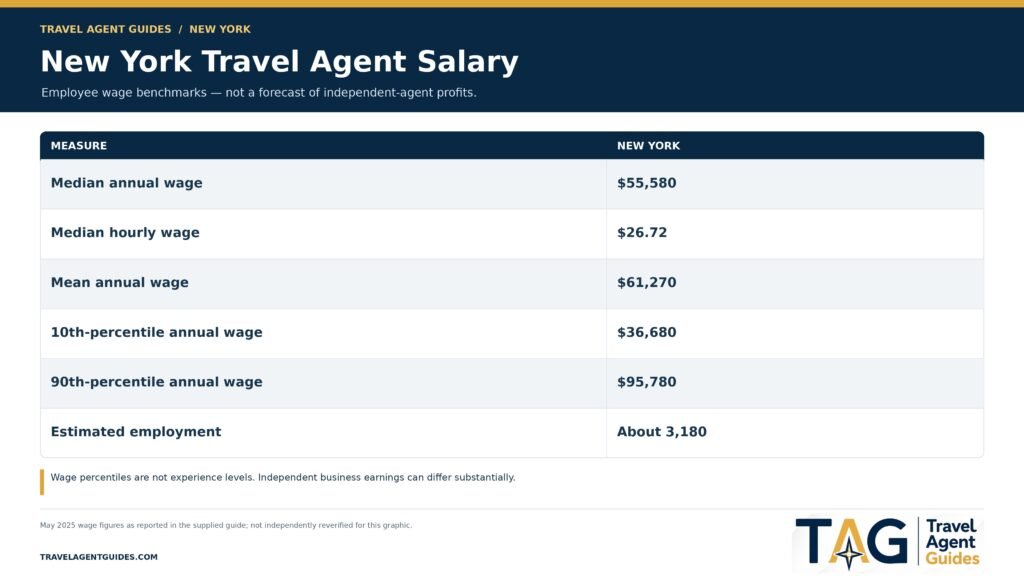
Here are the median salaries by metro area: New York City area is $58,430, Buffalo is $49,830, Syracuse is $49,310, Albany is $48,090, and Rochester is $45,320.
If you work as an independent agent, you earn money through commissions and planning fees instead of a salary. Commissions are typically paid after your client completes their trip. For example, if you book a cruise in November, you might not get paid until July. It’s a good idea to have some savings set aside for your first six to nine months.
How Much Does It Cost to Start?
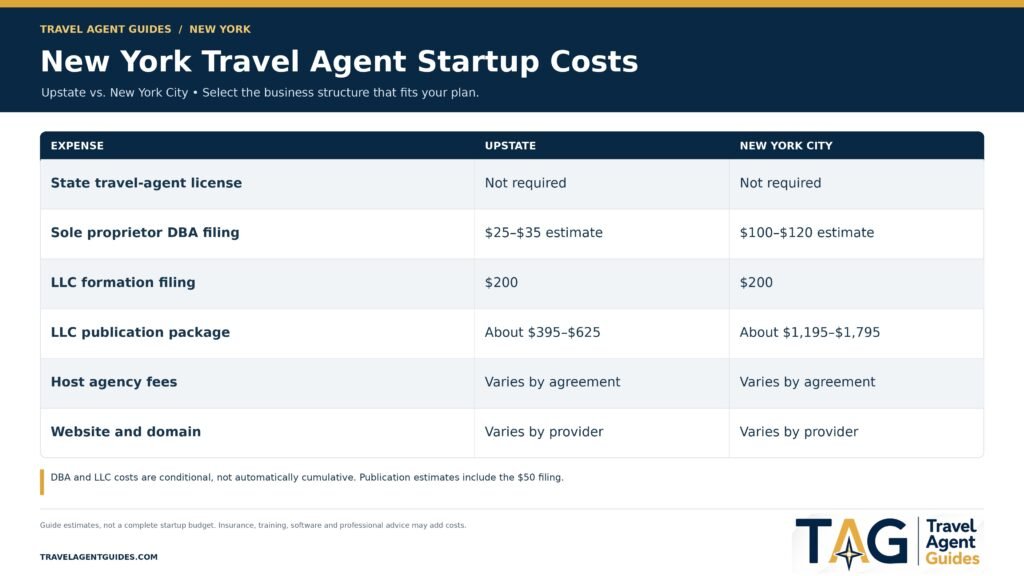
The most affordable way to get started is to work under your own name with a host agency. This way, you do not have to pay any state filing fees.

Common Mistakes New Agents Should Avoid
- Don’t pay for a so-called required license. New York doesn’t require one.
- If you form an LLC in Manhattan, remember to budget for the publication requirement. It can cost nearly $1,800.
- Don’t miss the 120-day publication deadline, or your LLC could be suspended.
- Never sell travel insurance without the proper license. Doing so is a serious compliance risk.
- Avoid putting client money into your personal account. This can lead to tax issues, chargebacks, and legal problems.
- Don’t call a hold or request “confirmed.” The Truth in Travel Act specifically addresses this issue.
- Don’t choose a host agency just for the commission split. Early on, training and support are even more important.
- Don’t overwhelm clients with too many choices. Instead, send three options: best value, best match, and a splurge.
- Don’t spend time doing free research for people who never book. Qualify your leads first, and think about charging a planning fee for complex trips.
- Don’t get stuck taking courses forever. Aim to start talking to clients by your second or third week.

Frequently Asked Questions
Do you need a license to be a travel agent in New York?
No, New York does not require a travel agent license or Seller of Travel registration. However, you must still follow the Truth in Travel Act.
How do I become a travel agent in New York with no experience?
Start by joining a host agency that offers beginner training. Choose a specialty, set up your business, and reach out to people you already know.
How much do travel agents make in New York?
The median salary is $55,580 per year, while top earners make $95,780 or more.
Can I be a travel agent from home in New York?
Yes, most independent agents work from home by partnering with a host agency.
Do I need an LLC to be a travel agent in New York?
No, you do not need an LLC. Many agents start as sole proprietors. Forming a New York LLC gives you liability protection, but you will need to meet the newspaper publication requirement.
Can New York travel agents sell travel insurance?
You can only sell travel insurance if you have the proper insurance license. The Department of Financial Services offers a limited license for this purpose.
Can I book clients in California or Florida?
Yes, as long as you are covered by a Seller of Travel registration in California or Florida. Most host agencies include this coverage.
How long does it take to start?
It usually takes about 1 to 4 weeks to start under your own name. If you form an LLC, expect about two extra months for the publication process.
Do I need my own IATA number?
No, you do not need your own IATA number. Your host agency’s credentials allow you to book travel and earn commissions.
Do NYC travel agents need a city license?
You do not need a city license to book trips from home. You only need a Sightseeing Guide license if you personally lead tours in New York City.
Do New York travel agents charge sales tax?
You usually do not need to charge sales tax on commissions or planning fees. If you mark up New York hotel rooms yourself, you must register and collect sales tax.
Does the NYC Unincorporated Business Tax apply to new agents?
This tax rarely applies in your first year. You generally do not have to file until your gross income is over $95,000.
Can I charge planning fees in New York?
Yes, you can. Make sure to explain the fee, what it covers, and your refund policy in writing before your client agrees.
What’s the fastest way to get clients in New York?
Reach out to people you know and take advantage of New York’s busy travel seasons, such as February break and no-fly cruises from NYC.

Are you ready to get started?
New York is a great place to start a travel business. You don’t need a special license, there’s strong demand, and cruise ships depart nearby. Just learn the state rules, choose your focus, and team up with a host agency that offers training and support.
People are already planning their next vacations. Join a host agency now and become the travel advisor they turn to!